At first glance, waterjet cutting may appear to be a straightforward process: pressurized water is directed at a workpiece to remove material. In practice, however, an ultra-high-pressure waterjet system relies on the coordinated operation of hydraulic systems, high-pressure mechanical components, fluid dynamics, precision motion systems, and CNC control technology.
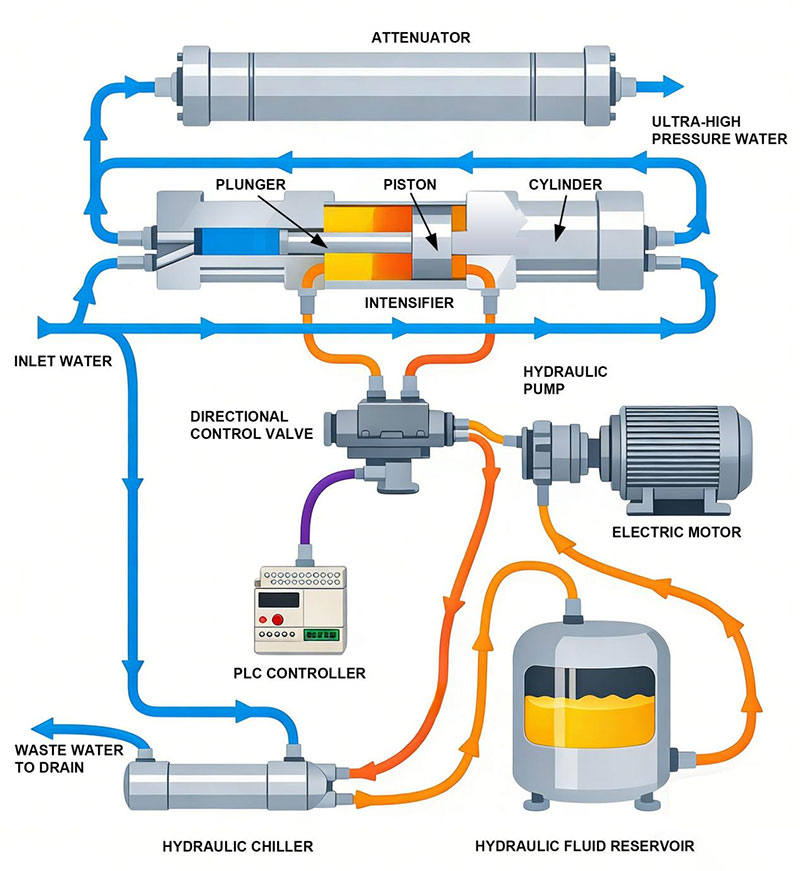
The entire cutting process begins with the generation of ultra-high-pressure water. In most industrial waterjet cutting machines, this pressure is produced by an intensifier pump, which converts hydraulic energy into extremely high water pressure.
How Does a Waterjet Cutting Machine Generate Ultra-High Pressure?
The process starts with the hydraulic power unit. Hydraulic oil is supplied by an oil pump and delivered to the intensifier. The relatively low-pressure hydraulic oil acts on a large-diameter piston, causing the piston to move back and forth inside the intensifier.
A directional control valve automatically changes the direction of hydraulic flow, allowing the piston to reciprocate continuously. This repeated movement is the basic mechanism used to convert hydraulic power into high-pressure water.
At the same time, incoming water passes through a multi-stage filtration system before entering the high-pressure circuit. Removing suspended particles and other impurities is essential because contaminants can damage precision components and reduce the reliability of the high-pressure system.
After filtration, the water enters the intensifier at relatively low pressure. Inside the intensifier, a smaller water piston is mechanically linked to the larger hydraulic piston. Because the water piston has a much smaller effective area, the hydraulic force is converted into a significantly higher water pressure.
This pressure multiplication principle is what enables an intensifier pump to generate ultra-high-pressure water.
How Is a Stable Waterjet Produced?
The reciprocating movement of the intensifier naturally creates pressure fluctuations. Without additional pressure management, these fluctuations could affect cutting consistency and surface quality.
To reduce this effect, the high-pressure water passes through an accumulator after leaving the intensifier. The accumulator stores and releases pressurized water as needed, helping absorb pressure pulses and maintain a more stable flow.
This pressure stabilization is particularly important during precision cutting. A consistent water supply allows the cutting head to produce a more uniform jet, helping improve cutting quality and dimensional accuracy.
From High Pressure to a High-Speed Cutting Jet
Once the water has been pressurized and stabilized, it is directed through a precision orifice with an extremely small opening. Depending on the cutting-head configuration, the orifice diameter is typically around 0.1–0.4 mm.
The high pressure forces the water through this tiny opening, converting pressure energy into kinetic energy and producing an extremely high-speed jet. Depending on the system configuration, waterjet velocity can approach 1,000 meters per second.
The resulting jet is highly concentrated and capable of removing material with considerable precision. Unlike conventional thermal cutting processes, pure waterjet cutting does not rely on heat to melt the workpiece.
For abrasive waterjet cutting, abrasive particles such as garnet are introduced into the high-speed water stream after it exits the orifice. The abrasive particles provide the additional cutting action required to process hard materials such as stainless steel, aluminum, titanium, stone, glass, ceramics, composites, and other difficult-to-machine materials.
This is one of the key advantages of waterjet technology: the same basic platform can be configured for both soft-material cutting and abrasive cutting of hard materials.
What Are the Main Components of a Waterjet Cutting Machine?
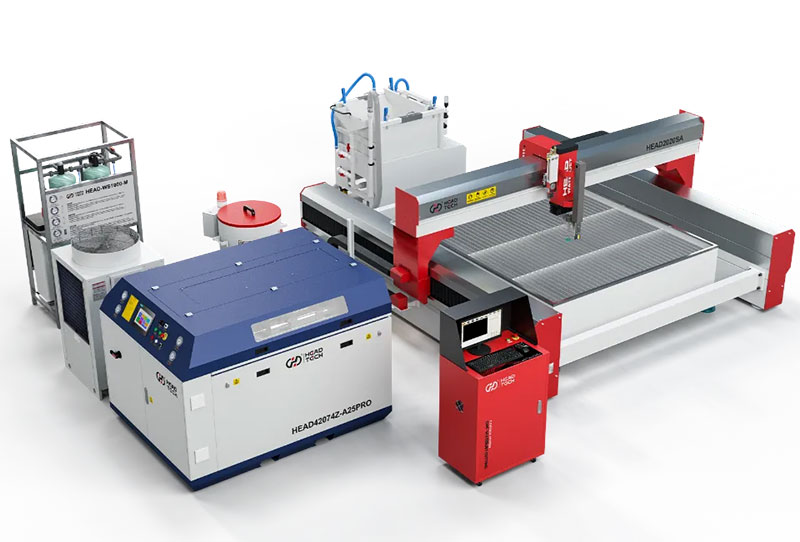
A complete waterjet cutting machine is not simply a high-pressure pump. It is an integrated system in which several subsystems work together to control pressure, water flow, abrasive delivery, cutting movement, and machine operation.
The major components typically include:
- High-Pressure Pump: Generates the ultra-high-pressure water required for the cutting process and has a major influence on system performance and reliability.
- CNC Control System: Controls machine movement, cutting parameters, and the overall cutting process through an industrial control interface.
- High-Pressure Water Switch: Controls the on/off operation of the high-pressure water and coordinates water and abrasive delivery during cutting.
- Abrasive Hopper: Stores and regulates abrasive material for abrasive waterjet cutting, helping maintain a consistent abrasive flow.
- Multi-Axis Motion System: Moves the cutting head along programmed paths with high positional accuracy and enables the machine to produce complex geometries.
- Cutting Head: Contains the precision orifice and mixing components responsible for forming and directing the cutting jet.
- Cutting Table: Supports the workpiece during machining while the water tank absorbs and dissipates the energy of the jet after it passes through the material.
The performance of these components is closely related. A reliable pump alone cannot guarantee high-quality cutting if the cutting head, motion system, abrasive delivery, or CNC control system is not properly matched.
High-Pressure Pump: The Core of the Waterjet System
The high-pressure pump is generally regarded as the power source of a waterjet cutting machine. Its ability to generate stable pressure directly influences cutting speed, cutting capability, edge quality, precision, energy consumption, and overall operating costs.
A well-designed intensifier pump incorporates multiple systems to maintain reliable operation under extreme pressure conditions.
Key High-Pressure Pump Features
- Advanced Intensifier Technology
An optimized intensifier structure provides efficient pressure conversion while supporting stable operation and long service life. - Hydraulic Oil Cooling System
An integrated heat exchanger helps control hydraulic oil temperature during extended operation, reducing the risk of excessive heat buildup. - Multi-Stage Water Filtration
Multiple filtration stages remove impurities from the incoming water and help protect precision components within the high-pressure system. - Low-Water Protection
Automatic protection functions can detect insufficient water supply and help prevent damage to critical pump components. - Hydraulic Oil Filtration and Monitoring
Oil filtration, cooling, and temperature monitoring work together to maintain the hydraulic system in suitable operating conditions. - Flexible Coupling
A flexible coupling helps reduce vibration between mechanical components, improving transmission stability and reducing mechanical stress. - High-Capacity Accumulator
The accumulator helps compensate for pressure fluctuations generated by the reciprocating intensifier and contributes to a more stable cutting jet. - Pressure Protection
Automatic shutdown and protective functions can respond to abnormal pressure conditions to improve operational safety and protect the equipment. - Star-Delta Motor Starting
A star-delta starter can reduce the electrical load during motor startup and help improve the stability of the electrical system. - Touchscreen Monitoring
A touchscreen interface allows operators to monitor important operating parameters and access system information and diagnostic functions. - Automatic Hydraulic Pressure Adjustment
Automatic pressure regulation helps maintain the required working pressure while improving hydraulic efficiency and adapting to different cutting conditions.
Together, these features help the high-pressure pump maintain stable performance during continuous industrial operation.
Water Switch and Cutting Head Technology
The water switch and cutting head form another critical part of the waterjet system. They determine how the high-pressure water is controlled, shaped, and delivered to the workpiece.
The cutting head must maintain accurate alignment between the jewel orifice and the mixing tube. Even a small deviation in alignment can affect jet quality and cutting performance. Proper alignment helps produce a more concentrated cutting jet while reducing uneven wear on components.
Water Switch
The high-pressure water switch is responsible for controlling the release of pressurized water to the cutting head. Pneumatic valve designs are commonly used because they can provide fast and reliable switching during the cutting process.
For abrasive waterjet systems, the water switch works together with the abrasive delivery system. After the high-pressure water passes through the orifice, abrasive particles are introduced into the high-speed jet and accelerated toward the workpiece.
This combination of high-pressure water and abrasive particles allows the system to cut materials that cannot normally be processed efficiently using pure water alone.
Cutting Head
The cutting head contains several precision components, including the jewel orifice and mixing tube. The orifice is responsible for forming the initial high-pressure water jet, while the mixing system introduces abrasive particles when abrasive cutting is required.
The quality and condition of these components have a direct effect on cutting consistency. A worn or damaged orifice or mixing tube can cause the jet to become less stable, potentially resulting in poorer edge quality, increased taper, or reduced dimensional accuracy.
For this reason, regular inspection and timely replacement of wear components are important parts of waterjet machine maintenance.
High-Pressure Piping and System Reliability
The high-pressure piping system is another essential part of an industrial waterjet machine. It must safely withstand extremely high operating pressures while maintaining reliable water delivery over long periods of operation.
High-quality high-pressure tubing, fittings, valves, and connections are selected and assembled according to the pressure requirements of the system. Proper installation and regular inspection are essential because the high-pressure circuit operates under demanding mechanical conditions.
A complete waterjet system therefore depends on more than pressure generation alone. Pump stability, pressure management, water filtration, cutting-head alignment, abrasive delivery, high-pressure piping, CNC control, and motion accuracy all contribute to the final cutting result.
How Does the Entire Waterjet Cutting Process Work?
The complete process can be summarized as a series of coordinated steps:
1. Water Supply →
Clean water enters the system through the filtration and purification stages.
2. Hydraulic Power →
The hydraulic pump supplies oil pressure to drive the intensifier piston.
3. Pressure Intensification →
The intensifier converts hydraulic energy into ultra-high-pressure water.
4. Pressure Stabilization →
The accumulator reduces pressure pulsation and helps maintain a stable water flow.
5. Jet Formation →
High-pressure water passes through the precision orifice and becomes a high-velocity jet.
6. Abrasive Mixing →
For abrasive cutting, garnet or another suitable abrasive is introduced into the waterjet.
7. CNC Motion →
The cutting head follows the programmed cutting path generated by CAD/CAM software.
8. Material Removal →
The concentrated waterjet, or abrasive waterjet, progressively removes material along the programmed path.
9. Energy Dissipation →
After passing through the workpiece, the remaining jet energy is absorbed by the cutting table and water tank.
This coordinated process allows a waterjet cutting machine to produce complex shapes and precise profiles across a broad range of materials.
Why Is Waterjet Cutting Considered a Versatile Cutting Technology?
The fundamental advantage of waterjet cutting is the combination of high-pressure fluid technology, precision motion control, and cold cutting.
Because the process does not depend on conventional thermal cutting, waterjet technology is suitable for materials and applications where heat input needs to be minimized. With abrasive cutting capability, the same equipment can also process many hard and thick materials.
For manufacturers, this provides considerable flexibility. A single waterjet cutting platform can be used for prototyping, custom fabrication, low-volume production, and demanding industrial applications.
Ultimately, the cutting quality of a waterjet machine depends on the performance of the entire system rather than one individual component. A properly engineered combination of ultra-high-pressure pump, accumulator, cutting head, abrasive system, motion platform, CNC control, and high-pressure piping provides the foundation for stable, accurate, and efficient waterjet cutting.