Waterjet cutting machines are widely used in metal fabrication, stone processing, glass manufacturing, automotive production, aerospace, composite material processing, and many other industrial applications. However, when buyers begin comparing different machines, one issue quickly becomes obvious: prices can vary dramatically.
Some waterjet systems are priced at only tens of thousands of dollars, while larger or more advanced machines can cost several hundred thousand dollars.
This price difference is not simply caused by brand positioning. In most cases, it reflects substantial differences in cutting capability, pump technology, machine structure, working size, automation level, CNC system, component quality, service support, and expected machine lifespan.
For buyers, understanding these factors is essential. A cheaper machine may reduce the initial investment, but it does not necessarily provide the lowest long-term operating cost or the best production value.
1. Cutting Process Has a Major Impact on Price
One of the first factors affecting waterjet machine price is the type of cutting process the equipment is designed to perform.
Pure Waterjet Cutting
Pure waterjet systems use only high-pressure water to remove material.
They are mainly suitable for relatively soft materials such as:
- Rubber
- Foam
- Paper
- Textiles
- Leather
- Food products
- Certain plastics
Because these systems do not require an abrasive delivery system, abrasive hopper, mixing chamber, or abrasive-resistant focusing tube, their mechanical structure can be simpler.
As a result, pure waterjet machines are generally less expensive than abrasive waterjet systems with similar working dimensions.
Abrasive Waterjet Cutting
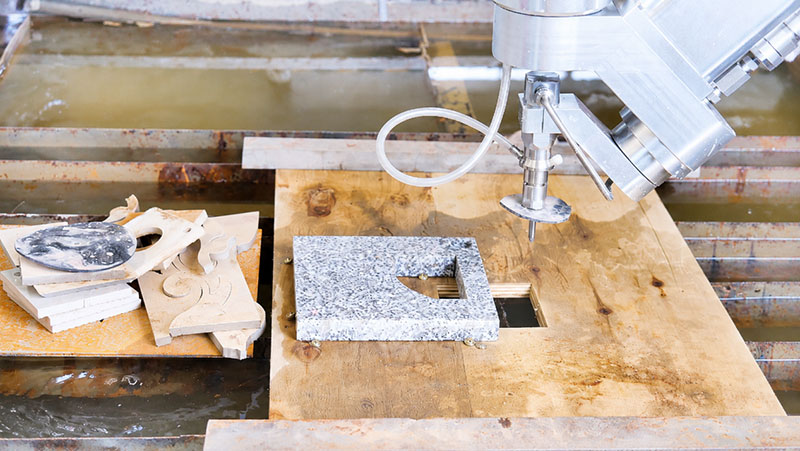
Abrasive waterjet machines introduce abrasive particles, commonly garnet, into the high-speed water stream.
This gives the cutting jet enough power to process much harder materials, including:
- Stainless steel
- Carbon steel
- Aluminum
- Titanium
- Marble
- Granite
- Glass
- Ceramics
- Carbon fiber
- Composite materials
However, abrasive cutting requires additional equipment and wear-resistant components, including abrasive feeding systems, abrasive metering devices, mixing chambers, and focusing tubes.
These additional systems increase both the initial machine price and the long-term operating cost.
Therefore, when two machines appear similar in size but have significantly different prices, the cutting process and abrasive configuration should be one of the first factors to compare.
2. The High-Pressure Pump Is One of the Most Important Cost Factors
The high-pressure pump is one of the most technically demanding and expensive parts of a waterjet cutting machine.
Its performance affects:
- Maximum cutting pressure
- Cutting speed
- Material thickness capability
- Pressure stability
- Energy consumption
- Maintenance frequency
- Cutting consistency
- Long-term reliability
Entry-level machines may use relatively basic pump systems designed for moderate operating pressure and lower production intensity.
More advanced industrial systems may use higher-performance pumps with stronger pressure stability, better cooling, more sophisticated hydraulic control, improved filtration, and longer maintenance intervals.
A lower-priced pump may reduce the machine purchase price, but buyers should also consider the cost of:
- High-pressure seals
- Intensifier components
- Valves
- Hydraulic oil
- Filters
- Maintenance labor
- Spare parts
- Production downtime
In industrial applications, pump reliability can have a greater impact on long-term production cost than the difference in initial purchase price.
3. Machine Size Directly Influences Manufacturing Cost
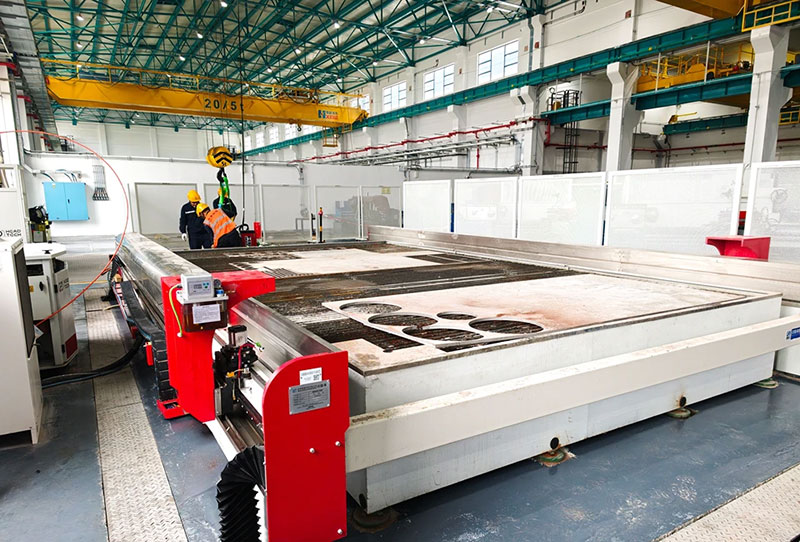
The working area of a waterjet cutting machine has a significant effect on price.
A compact machine designed for small sheets requires less structural material and shorter motion components. In comparison, a large-format cutting machine requires a stronger mechanical structure to maintain rigidity and positioning accuracy across a much larger travel distance.
Increasing the table size may require:
- Larger machine frames
- Longer guide rails
- Stronger gantries
- Larger water tanks
- Higher-capacity support structures
- Longer precision transmission systems
- Additional reinforcement
A larger machine is therefore not simply a scaled-up version of a smaller one. Maintaining accuracy over a large working area requires considerably more engineering and manufacturing effort.
Buyers should select the working size according to the actual dimensions of the materials they process rather than automatically choosing the largest available model.
4. Three-Axis and Five-Axis Waterjets Have Different Price Levels
Axis configuration is another major reason for differences in waterjet cutting machine prices.
A standard three-axis machine controls movement along the X, Y, and Z axes and is suitable for many conventional 2D cutting applications.
For flat sheets, metal plates, stone slabs, and similar materials, a three-axis system can often provide an effective balance between investment and cutting capability.
A five-axis waterjet cutting machine adds rotational or tilting movement to the cutting head.
This makes it possible to perform operations such as:
- Bevel cutting
- Angle cutting
- Taper compensation
- Complex contour cutting
- Edge preparation
- More advanced 3D geometries
The additional axes require more sophisticated mechanical components, servo systems, motion-control software, calibration procedures, and CNC functions.
As a result, five-axis waterjet systems usually cost significantly more than standard three-axis machines.
However, for customers who regularly require bevels or complex geometry, the additional capability may reduce secondary machining and improve overall productivity.
5. Cutting Head Quantity and Configuration Affect Cost
Not all waterjet machines are equipped with a single cutting head.
Some production environments use two or more cutting heads simultaneously to increase output, especially when identical parts need to be produced repeatedly.
A dual-head configuration may improve throughput, but it also requires:
- Additional cutting heads
- Additional abrasive control
- More complex pressure distribution
- Wider cutting-table design
- More demanding motion coordination
Special cutting heads designed for bevel cutting, height sensing, collision protection, or precision taper compensation can also increase equipment cost.
Buyers should therefore compare cutting-head configurations carefully when evaluating quotations.
6. CNC Control Systems Create Significant Price Differences
Modern waterjet machines depend heavily on their CNC control systems.
A basic controller may provide essential functions such as axis movement, file import, cutting-path execution, and parameter adjustment.
Higher-end systems can provide additional capabilities including:
- Automatic nesting
- Cutting parameter databases
- Kerf compensation
- Taper compensation
- Automatic lead-in and lead-out control
- Collision avoidance
- Real-time machine monitoring
- Automatic height control
- Diagnostic functions
- Production management
These features can reduce programming time and operator dependence.
For companies processing many different jobs each day, advanced CNC capabilities may provide substantial productivity advantages.
The control system should therefore be evaluated not only according to hardware cost, but also according to how much operator time, material waste, and production preparation it can save.
7. CAD/CAM Software Also Influences the Overall Investment
Waterjet cutting machines generally rely on CAD/CAM software to convert drawings into usable cutting programs.
Entry-level software may only provide basic toolpath generation.
More advanced systems can optimize:
- Nesting
- Cutting sequence
- Corner control
- Piercing strategy
- Cutting speed
- Material utilization
- Taper compensation
Better software can significantly reduce waste and shorten preparation time.
For manufacturers processing expensive materials such as titanium, stainless steel, stone slabs, or composite sheets, even a small improvement in nesting efficiency can produce meaningful cost savings over time.
Therefore, software quality should be considered part of the machine investment rather than treated as an optional accessory.
8. Machine Structure and Mechanical Precision Matter
Two waterjet machines with the same nominal working size can still have very different prices because their mechanical structures may be completely different.
A heavier and more rigid machine frame is generally more expensive to manufacture, but it can provide better stability during long-term operation.
Important structural factors include:
- Frame rigidity
- Gantry design
- Guide rail quality
- Transmission system
- Servo motors
- Ball screws or rack systems
- Protective covers
- Water tank structure
- Corrosion protection
Precision components also contribute to cost.
Higher-quality motion systems may provide better positioning accuracy, repeatability, and long-term stability.
For industrial buyers, these factors are particularly important because small differences in mechanical quality may become more noticeable after several years of continuous operation.
9. Automatic Abrasive Feeding Adds Cost but Can Improve Productivity
A basic abrasive waterjet machine may use a relatively simple abrasive supply system.
More advanced machines can be equipped with automatic abrasive feeding and monitoring systems.
These systems help maintain a stable abrasive flow and reduce the frequency of manual refilling.
Additional functions may include:
- Abrasive level monitoring
- Automatic feeding
- Flow regulation
- Blockage detection
- Pressure monitoring
Although these functions increase the initial equipment price, they can reduce operator workload and improve production continuity.
For factories running long shifts or multiple machines, automatic abrasive management may provide greater operational value than its initial cost suggests.
10. Water Recycling and Filtration Systems Can Increase the Purchase Price
Water quality is critical to high-pressure waterjet operation.
Depending on local water conditions and environmental requirements, some machines may require additional treatment systems.
These can include:
- Multi-stage filtration
- Water softening
- Reverse osmosis treatment
- Cooling systems
- Water recycling
- Sludge handling
- Wastewater management
A simple machine quotation may not include these systems, while a more complete production solution may incorporate them from the beginning.
This can create a noticeable price difference between suppliers even when the cutting machines themselves appear similar.
When comparing quotations, buyers should confirm exactly which auxiliary systems are included.
11. Automation Level Strongly Affects Waterjet Machine Price
Automation is becoming increasingly important in modern manufacturing.
A basic waterjet machine may require manual loading, positioning, programming, monitoring, and unloading.
More advanced systems may include:
- Automatic loading
- Automatic unloading
- Material positioning
- Height sensing
- Automatic abrasive supply
- Remote monitoring
- Production scheduling
- Robot integration
Higher automation reduces manual intervention and can improve production consistency.
However, each automation function requires additional sensors, control hardware, software, mechanical systems, and system integration.
This is why fully automated waterjet production systems can cost considerably more than stand-alone machines.
For high-volume production, however, the higher investment may be justified by lower labor requirements and higher utilization.
12. Component Brands Can Create Large Price Differences
The brands and quality levels of key components also influence machine price.
Waterjet systems use numerous industrial components, including:
- Servo motors
- PLCs
- CNC controllers
- Electrical components
- Guide rails
- Ball screws
- Pumps
- Valves
- High-pressure tubing
- Sensors
Industrial-grade components from established suppliers are typically more expensive than generic alternatives.
However, better component quality can improve reliability, reduce failure frequency, and make spare parts easier to source.
For equipment expected to operate for many years, component availability is especially important.
A machine is only productive when replacement parts can be obtained quickly.
13. After-Sales Service Is Part of the Machine Price
Service capability is another important reason why waterjet prices differ between suppliers.
A low-cost supplier may provide basic remote support but limited installation assistance or local service coverage.
More established manufacturers may provide:
- Installation guidance
- On-site commissioning
- Operator training
- Remote diagnostics
- Spare-parts support
- Preventive maintenance advice
- Technical troubleshooting
- Application support
These services require engineering resources and therefore contribute to the overall equipment price.
However, their value becomes clear when a machine experiences unexpected problems.
For an industrial factory, a machine stopped for several days can create production losses far greater than the cost difference between two suppliers.
14. Customization Can Significantly Change the Final Price
Many waterjet machines are not purchased as completely standard products.
Customers may require special configurations based on material, factory layout, production process, or automation requirements.
Customization may involve:
- Extended Z-axis travel
- Larger cutting tables
- Pipe-cutting fixtures
- Rotary axes
- Special clamping systems
- Laser positioning
- Height sensing
- Automatic loading
- Full protective enclosures
- Customized software
- Robot integration
Every customized configuration requires additional engineering, manufacturing, testing, and commissioning.
Therefore, customized waterjet systems can be considerably more expensive than standard machines, even when the basic cutting platform is similar.
15. Brand Experience and Manufacturing Capability Influence Price
Established waterjet manufacturers often invest heavily in engineering, quality control, testing, manufacturing infrastructure, and technical support.
These investments are reflected in equipment pricing.
HEAD Waterjet has focused on waterjet cutting technology and equipment manufacturing since 2009. Over the years, the company has accumulated experience across a wide range of applications and materials, including metal, stone, glass, composite materials, automotive components, and specialized industrial cutting.
The value of an experienced manufacturer is not limited to producing the machine itself.
Application experience can help customers select more appropriate:
- Pump configurations
- Cutting-head types
- Table dimensions
- Automation systems
- Cutting parameters
- Auxiliary equipment
This can reduce the risk of purchasing a machine that is technically capable of cutting a material but poorly matched to the customer’s actual production requirements.
Waterjet Cutting Machine Price Comparison
| Factor | Entry-Level Waterjet | Mid-Range Waterjet | Advanced Industrial Waterjet |
| Cutting Process | Pure Water / Basic Abrasive | Abrasive Waterjet | Advanced Abrasive / Multi-Axis |
| Pump Capability | Low to Medium | Medium to High | Ultra-High Pressure |
| Working Area | Small | Medium | Large or Customized |
| Axis Configuration | Mainly 3-Axis | 3-Axis / Optional Multi-Axis | 5-Axis / Specialized |
| CNC System | Basic | Advanced | Intelligent / Highly Automated |
| Abrasive System | Manual / Basic | Automatic Options | Fully Integrated |
| Automation | Limited | Semi-Automatic | Highly Automated |
| Customization | Limited | Moderate | Extensive |
| Service Support | Basic | Regional / Manufacturer Support | Comprehensive Technical Support |
| Initial Investment | Lower | Medium | Higher |
| Application Range | Basic Applications | General Industrial Production | Complex and High-Value Applications |
Is a More Expensive Waterjet Always Better?
Not necessarily.
A high-end waterjet machine with five-axis cutting, automatic abrasive supply, advanced software, and a large table may be unnecessary for a factory that only cuts small rubber sheets.
Likewise, choosing a very basic machine simply because it has the lowest price can be a mistake if the factory needs to cut thick stainless steel continuously.
The correct approach is to select the machine according to actual production requirements.
Important questions include:
- What materials will be cut?
- What is the maximum material thickness?
- What sheet size is normally processed?
- What cutting accuracy is required?
- Is bevel cutting necessary?
- How many hours will the machine operate each day?
- What production volume is expected?
- Is automatic loading required?
- How important is local service support?
- What is the expected machine lifespan?
Answering these questions provides a much more useful basis for equipment selection than simply comparing quotations.
Purchase Price vs Total Cost of Ownership
Another common mistake is assuming that the cheapest quotation represents the lowest-cost machine.
The real cost of a waterjet system includes more than the initial purchase price.
Buyers should also consider:
- Electricity
- Water
- Abrasive
- Nozzles and mixing tubes
- Pump maintenance
- Spare parts
- Labor
- Software
- Downtime
- Machine depreciation
A machine that costs less initially but requires frequent maintenance may become more expensive over several years of operation.
Conversely, a machine with a higher initial investment may provide better long-term economics if it offers higher uptime, lower maintenance costs, better material utilization, and a longer service life.
Conclusion: Choose Waterjet Equipment Based on Value, Not Price Alone
The large variation in waterjet cutting machine prices reflects real differences in technology, machine structure, pump performance, cutting capability, automation, component quality, software, customization, and service support.
There is no single price level that is suitable for every customer.
A small workshop, a stone fabrication company, an automotive supplier, and an aerospace manufacturer may all require completely different waterjet configurations.
Instead of asking only, “How much does a waterjet cutting machine cost?”, buyers should also ask:
“Which configuration provides the best balance of cutting capability, reliability, operating cost, and productivity for my application?”
The right waterjet cutting machine is not necessarily the cheapest or the most expensive option. It is the machine that matches the actual production requirements and delivers reliable performance and a reasonable return on investment throughout its service life.